

One Hand Haggles, the Other Hands Out Sanctions
Back in Chicago, I knew a corner-store owner who smiled at customers so warmly you wanted to buy things you didn’t need. Under the counter he kept a baseball bat. He never once used it. But everyone on the block knew it was there, and that is exactly why nobody argued with him. Beijing’s last 24 hours reminded me of that man down to the last detail. Start with the smile. On October 12, China’s Commerce Ministry reported on intensive consultations with the Europeans over hybrid and electric cars. Beijing insists on non-discriminatory allocation of export quotas and talks of a mechanism to raise permitted volumes relative to 2025 levels. That is a significant addition to the European Commission’s October 9 message about a possible sharp cut in Chinese hybrid exports. Both sides confirm the talks go on. The final numbers, and how they will be applied, remain open.
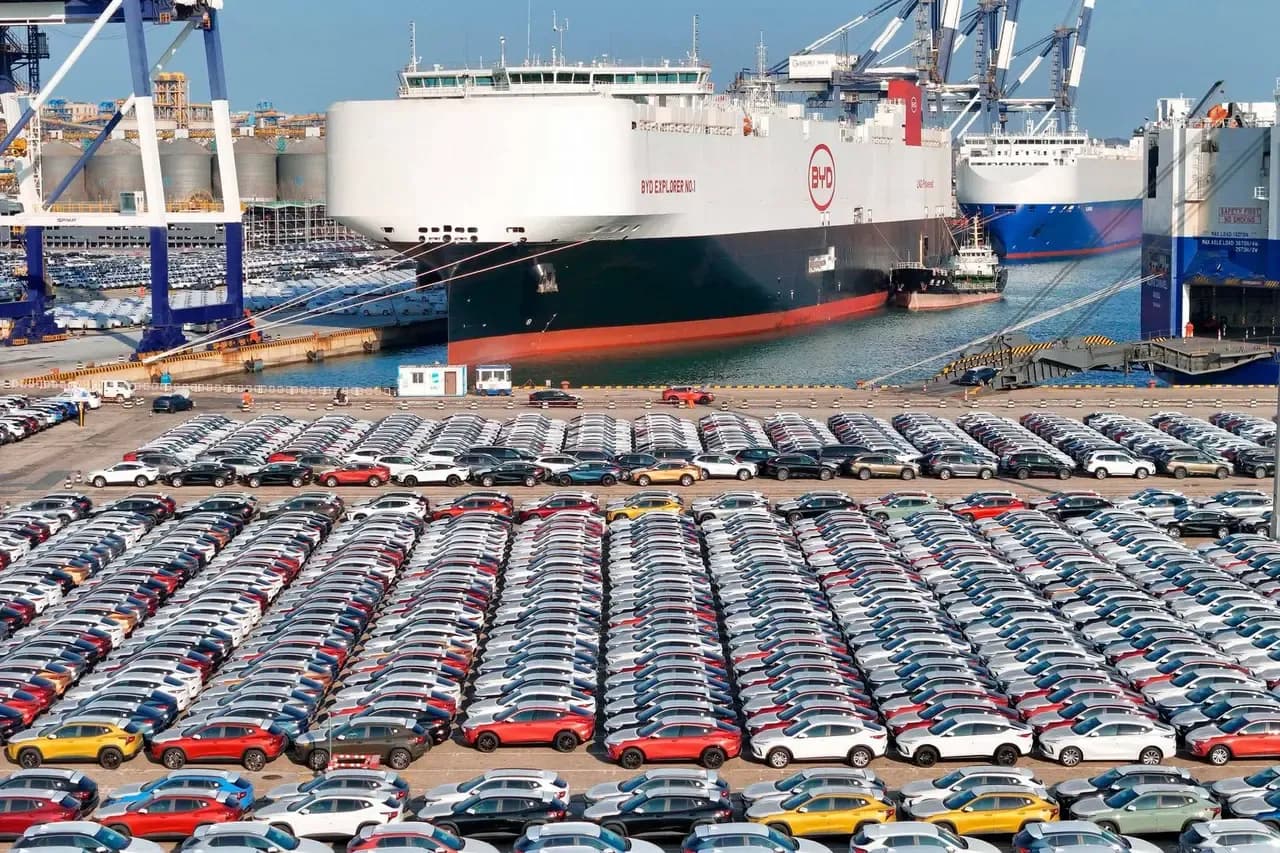
The real story is not in the quotas but in what flows from them. Reuters Breakingviews points out that such a deal could speed up the localization of Chinese car production inside the EU itself. Companies already invested in European factories can offset export curbs by building on the spot. Newcomers have a harder time. So the compromise may change not how many Chinese cars end up on European roads but where they are born. Brussels might find it has shown the Chinese the door only to watch them climb back in through the window, hard hats on.
Now the home front. On October 9, China earmarked 550 billion yuan of unused debt quotas to prop up the economy: 300 billion to keep local governments running, 250 billion for infrastructure. The decision comes against weak domestic demand and a property slump that refuses to end, with the official 2026 growth target at 4.5% to 5%. Local budgets are no side issue. They carry infrastructure, education and public services, and they feed largely on property and land revenue. When construction cools, the money dries up, but the bills keep arriving. Fresh funds ease the short-term squeeze without solving the debt pile. It’s a plaster on a leaking tap: fine for tonight.
Tech, of course, keeps the economy afloat too. The IMF says AI investment is feeding demand for Asian technology goods, and for China that is one more engine of activity. But exporting chips and gadgets cannot replace a consumer clutching his wallet. Fresh official industrial data that would justify talk of an acceleration is, so far, nowhere to be found.
Now, the bat under the counter. The same day, China’s Foreign Ministry sanctioned two foreign ministers: Paraguay’s ICT minister Gustavo Villate and Belize’s foreign minister Francis Fonseca. The reason was spelled out plainly: their actions in keeping diplomatic ties with Taiwan alive. They are barred from Hong Kong and Macau, and certain forms of cooperation with Chinese organizations are banned. Paraguay and Belize are among the twelve states that officially recognize Taipei. The direct economic damage is probably small. The political message is loud: befriend the island and expect personal trouble. For small countries, choosing a partner stopped being a matter of taste a long time ago.
Strange things are happening at sea, too. Taiwan’s defense minister, Wellington Koo, said the military is closely watching a series of Chinese live-fire drills. Chinese maritime authorities announced shipping restrictions in five coastal areas, from the South China Sea up to Liaoning province, with the zone nearest Taiwan lying off Zhejiang. Reuters stresses that these zones do not sit directly around the island, so calling it a blockade would be wrong. But recent years have taught us one thing. A show of force is not always the prelude to war. It is always a reminder that war is possible.